
Lesson 6 — The Bill of Lading and the Driver's Phone
The test below stays in English. You must pass the test in English.
Lesson 6 — The Bill of Lading and the Driver's Phone
The paperwork you don't send is the time the driver loses.
Why this matters
The driver needs paperwork. Without it, the driver cannot pick up the load, cannot enter the right BOL number into the ELD, cannot prove what is in the truck at a roadside inspection, and cannot drop the load at the receiver.
The thesis applied to paperwork: the paperwork you do not send is the time the driver loses. A driver waiting at a dock for paperwork dispatch never sent is a driver on the 14-hour clock with the truck not moving. Detention hours are not paid driving hours, but they ARE on-duty hours under HOS — they eat the same 14-hour window.
ATRI's 2024 detention study quantified what happens next: drivers dispatched to facilities known for delays drove 14.6% faster on average, both before arriving AND after leaving. They were recovering lost hours. Paperwork gaps cause detention. Detention causes speeding. Speeding causes citations. The carrier's CSA Unsafe Driving score is the cumulative result.
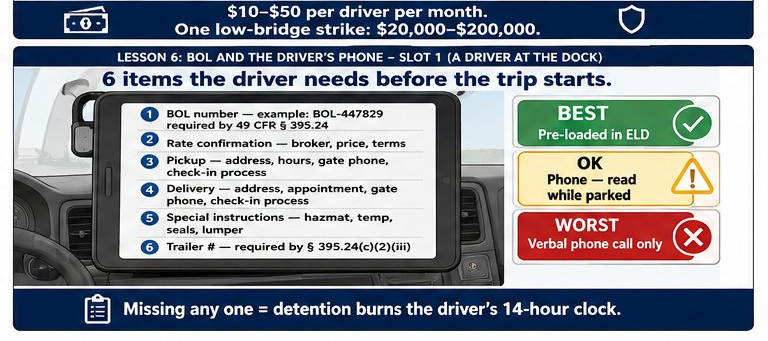
The 6 items every driver needs before the trip starts
- BOL (Bill of Lading) number. The shipper's identifier for the load. Driver must enter it in the ELD under 49 CFR § 395.24.
- Rate confirmation. The agreed price, broker, payment terms — proves the carrier is authorized to move this load.
- Pickup address, pickup hours, gate contact phone and check-in process. Most facilities are first-come-first-served or assign the door at the guard shack — dispatch usually cannot send a door number. What dispatch CAN send: the gate number, the after-hours contact, lumper requirements, and what to do if the driver is early or late.
- Delivery address, delivery appointment time, gate contact phone and check-in process. Same reality at the receiver — the door comes from the receiver's gate, not from dispatch. What dispatch CAN send: appointment confirmation number, gate procedures, after-hours contact, and detention-pay terms if the customer pays it.
- Special instructions. Hazmat placards, temperature settings, security seals, lumper pay, after-hours phone numbers.
- Trailer number / trailer type. Required in the ELD under § 395.24(c)(2)(iii).
Connect: if any one of these is missing when the driver arrives at pickup, dispatch will be on the phone fixing it during the driver's 14-hour clock. That is detention with your name on it.
How to deliver paperwork — best to worst
BEST — Pre-loaded into the ELD / tablet. Driver sees all 6 items on the in-cab device before starting the trip. BOL number is ready to enter. No phone use while driving.
This is what the trucking industry built ELDs for. Use it.
ACCEPTABLE — Driver's phone via app, email, or text. All 6 items sent in writing, before the trip starts, so the driver can review while still parked.
Driver must be parked when they read it. If they read it while driving, that is the VTTI 23x distraction scenario you created.
WORST — Phone call only, verbally during the trip. Driver has to write things down while operating. No record. Information gets dropped.
This is how loads turn into 4-hour detention events. Avoid completely.
Image 1 — A driver at the dock
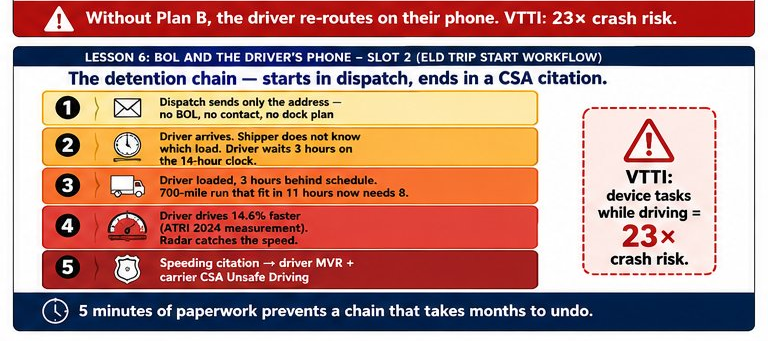
The detention chain — how it starts in dispatch and ends in a CSA citation
Step 1: Dispatch sends only the pickup address — no BOL number, no dock door, no contact name.
Step 2: Driver arrives. Shipper does not know which load this is. Driver waits 3 hours while dispatch and shipper sort it out. Driver's 14-hour clock is running.
Step 3: Driver gets loaded. Driver has lost 3 hours from the day's plan. The 700-mile run that fit comfortably in 11 hours now needs to happen in 8.
Step 4: Driver speeds. ATRI measured this — 14.6% faster on average for trucks dispatched into known-delay facilities. The speeding shows up on radar.
Step 5: Driver gets a speeding citation. MVR. CSA Unsafe Driving. The chain started in dispatch with the missing paperwork.
What you do as a dispatcher
- Send all 6 items before the trip starts. Pre-loaded in the ELD if possible. App/email/text if not. Never phone-only.
- Confirm the driver received and understood. Quick reply or read-receipt before dispatch is complete.
- If something changes mid-trip, send it in writing. Driver pulls over to read. Not while driving.
- Track detention. If a customer routinely holds drivers, that is data the carrier needs — for billing, for scheduling future loads, and for the customer conversation about appointment times.
The thesis, restated
The paperwork you do not send is the time the driver loses. The time the driver loses is the speed they make up. The speed they make up is the citation on the driver's MVR and the carrier's CSA Unsafe Driving score. Five minutes of dispatcher paperwork prevents a chain of consequences that takes months to undo.
Next step
Take the short quiz below. 5 questions in English. You need 4 of 5 correct to pass.
Image 2 — ELD trip start workflow
📋 Sample Quiz Questions (Preview)
These are the questions on the quiz at the end of this lesson. The actual quiz is taken after logging in. Correct answer marked with ✓.
- ○ Paused — waiting at a dock does not count
- ○ Reset — once stopped, the clock restarts
- ✓ Running — On Duty Not Driving counts against the 14-hour duty window
- ○ Only running if the truck is moving
- ○ 5% faster
- ✓ 14.6% faster on average — both before arriving and after leaving
- ○ No measurable difference
- ○ Slower, because of driver fatigue from waiting
- ○ Verbal phone call > text message > email — anything fast
- ✓ Pre-loaded in the ELD/tablet > driver phone (app/email/text) read while parked > phone call only (worst)
- ○ Email only — paper trail is what matters
- ○ Whatever method the driver prefers
- ○ The driver can skip the entry — it is optional
- ○ The shipper enters it for the driver
- ✓ The driver may enter it wrong or skip it — both become violations on the carrier's record under § 395.24
- ○ The ELD automatically detects it
- ○ The driver waits and calls dispatch, no other action
- ✓ The driver speeds afterward to recover the lost hours — ATRI's documented 14.6% faster pattern
- ○ The driver requests detention pay and is otherwise unaffected
- ○ Detention does not affect driver behavior
End of preview. The actual quiz requires login to record a grade.