
Lesson 3 — Is the Truck Healthy?
The test below stays in English. You must pass the test in English.
Lesson 3 — Is the Truck Healthy?
Dispatch a defective truck, the driver bears the roadside out-of-service.
Why this matters
The driver has hours. That is not enough. The truck must also be ready.
The thesis applied to equipment: dispatch a defective truck, the driver bears the roadside out-of-service. The driver gets parked. The driver gets the citation on their MVR. The driver loses the day's miles, the day's pay, and sometimes the load. The carrier gets the citation on CSA Vehicle Maintenance.
Virginia Tech Transportation Institute's SHRP 2 naturalistic driving study found that driver-related factors are present in about 90% of high-severity crashes. But many of those drivers were in trucks that should not have been on the road. The DVIR — Driver Vehicle Inspection Report — is the legal record of equipment fitness under 49 CFR § 396.11 and § 396.13. Dispatching a load on a truck with an open DVIR defect is the dispatcher's signature on the violation.
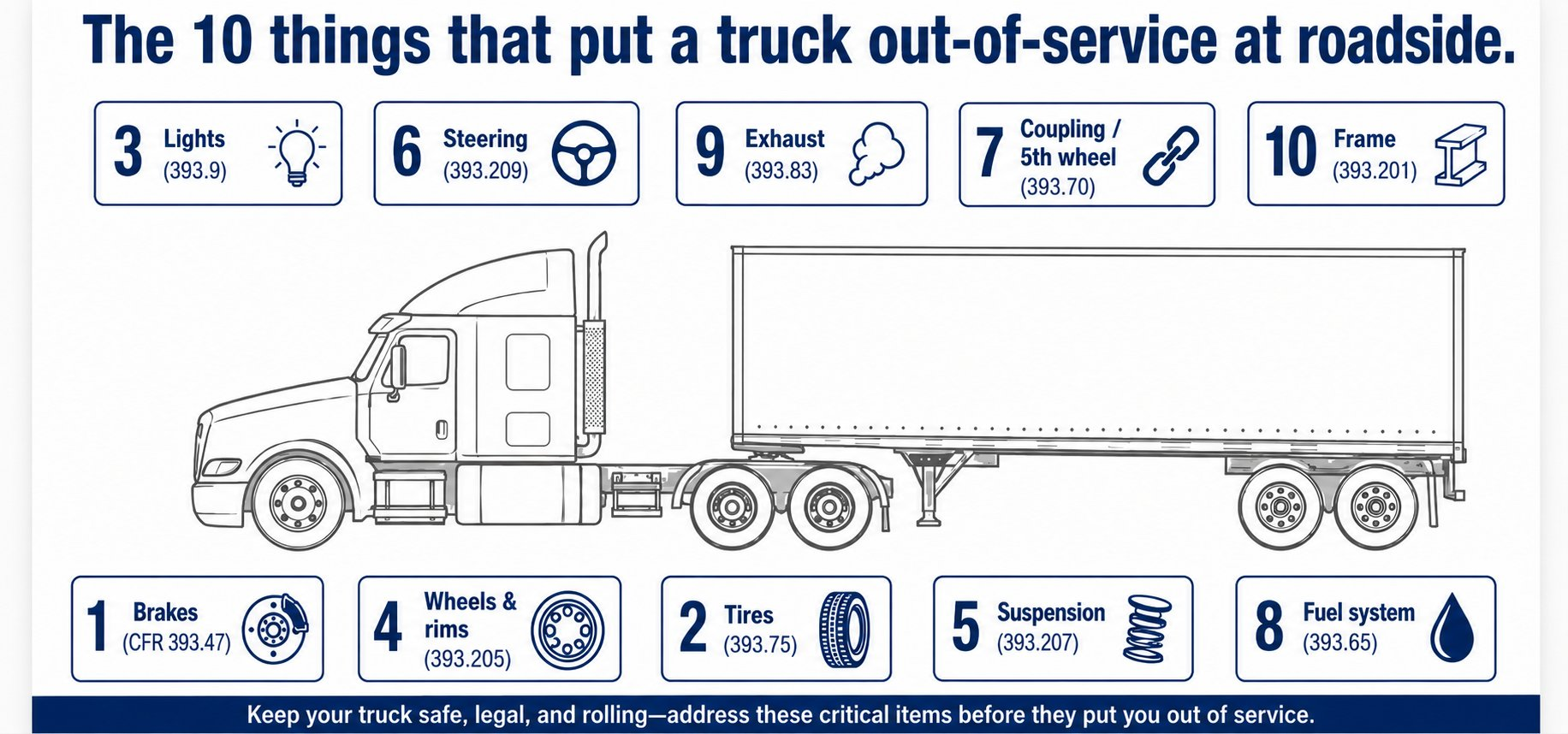
The 10 things that get a truck parked at roadside
CVSA (Commercial Vehicle Safety Alliance) maintains the official Out-of-Service criteria. The 10 most common roadside OOS findings:
- Brake adjustment / brake defects (49 CFR § 393.47, § 393.48) — 20% of truck OOS findings nationwide
- Tires — tread depth under 2/32" steer, under 1/32" drive/trailer; sidewall cuts; flat or audibly leaking (§ 393.75)
- Lights — required lights inoperative; clearance lights missing (§ 393.9)
- Wheels and rims — cracked, broken welds, missing fasteners (§ 393.205)
- Suspension — broken leaves, missing/loose U-bolts (§ 393.207)
- Steering — excessive lash, defective components (§ 393.209)
- Coupling devices — fifth wheel cracks, missing pins, kingpin damage (§ 393.70)
- Fuel system — leaks at the fuel tank or fuel line (§ 393.65)
- Exhaust system — leaks ahead of/below the cab (§ 393.83)
- Frame — cracks, breaks (§ 393.201)
Connect: every one of these is on the DVIR if the driver inspects honestly. Every one is visible to dispatch in the fleet portal before the load is assigned.
Image 1 — DVIR walkaround
Open vs. fixed defects — the dispatch decision
A DVIR shows two kinds of items:
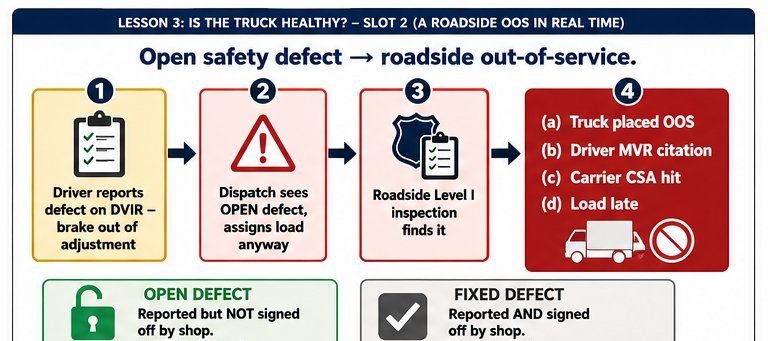
- Open defect: the driver reported it; the shop has not signed it off. The truck is NOT ready to dispatch.
- Fixed defect: the driver reported it; the shop fixed it and signed the DVIR. The truck IS ready.
The dispatcher's job is to see the open defects list and refuse to assign loads on trucks that have safety items open. Non-safety items (a missing cup holder, a torn seat cover) do not block dispatch. Safety items do.
What happens at roadside when you dispatch a defective truck
Truck pulls into a Level I inspection. Inspector finds the open defect. Several things happen at once:
- Truck placed out-of-service. Cannot move until the defect is fixed. Driver waits at the scale or finds a mobile mechanic.
- Driver ticketed. The driver signed the DVIR; the driver signed the pre-trip; the citation lands on the driver's MVR.
- Carrier ticketed. CSA Vehicle Maintenance BASIC takes the hit. Multiple events compound.
- Load is late. Customer angry. Recovery costs.
- OOS event recorded on CSA, visible to brokers, insurers, and shippers running the carrier's report.
All of this from a defect that was visible in the fleet portal 5 minutes before you assigned the load.
What you do as a dispatcher
- Before every assignment, look at the truck's DVIR. Fleet portal shows it. 30 seconds.
- If there is an open SAFETY defect — do not assign that truck. Use a different truck, send the defective one to the shop, or delay the load.
- Do not pressure the driver to "run it anyway." A driver who is told to run with an open defect can refuse under whistleblower protections (49 USC § 31105). The carrier is exposed.
- Do not pressure the driver to skip the pre-trip. Pre-trip is the driver's legal obligation under § 396.13; pressuring them to skip it is itself a violation.
The thesis, restated
Dispatch a defective truck, the driver bears the roadside out-of-service. The dispatcher pushes (or fails to check), the driver pays in citations, parked hours, and lost income — and the carrier pays in CSA Vehicle Maintenance, broker access, and insurance.
Next step
Take the short quiz below. 5 questions in English. You need 4 of 5 correct to pass.
Image 2 — A roadside OOS in real time
📋 Sample Quiz Questions (Preview)
These are the questions on the quiz at the end of this lesson. The actual quiz is taken after logging in. Correct answer marked with ✓.
- ○ Driver Vehicle Insurance Record — required for liability purposes
- ○ Daily Vehicle Inspection Receipt — required by carrier policy
- ✓ Driver Vehicle Inspection Report — required by 49 CFR § 396.11 (driver) and § 396.13 (repair)
- ○ Department of Vehicle Inspection Registry — federal database
- ○ Nothing — DVIRs are advisory, not enforced at roadside
- ○ Only the carrier is cited; the driver is fine
- ✓ Truck placed OOS, driver ticketed (MVR), carrier ticketed (CSA Vehicle Maintenance), customer late, recovery cost
- ○ Driver gets a warning; truck released
- ○ Call the driver and ask
- ○ Wait until the driver arrives at pickup
- ✓ The fleet ELD portal — DVIRs upload electronically and are visible to dispatch in seconds
- ○ The truck's glove compartment
- ○ All three — every defect blocks dispatch
- ○ Only the oil leak
- ✓ (1) cracked windshield AND (2) oil leak — both are safety defects under CVSA OOS criteria; (3) missing fuel cap is a non-safety / cosmetic finding
- ○ None — these are minor
- ○ Reasonable dispatch decision under pressure
- ✓ Coercion under 49 CFR § 390.6 — and the driver has whistleblower protection under 49 USC § 31105 to refuse
- ○ The driver's decision either way
- ○ Standard industry practice
End of preview. The actual quiz requires login to record a grade.